
Prior know-how is assumed here, and the items become more “technical” toward the bottom.
Four things, if you read nothing else
- Search the City’s code for “barking” and near the top you get a zoning table about decorative bark chips for landscaping. Search “park” and the first ten of fifty-seven results are all about parking. → U1
- Four headings under “DOGS” have nothing beneath them. One of them reads “License; required” — repealed in 2013, still listed, with no pointer to the rule that replaced it. → S10
- Since May 2025 a biting cat has been treated more seriously than a biting dog. The same 1951 rule, amended for dogs and left alone for cats. → S6
- Ten city parks, and not one sign about dogs. One park has a post carrying four signs — camping, hours, liability, thunderstorms. Not dogs. → S1
Part one — structure of the ordinances
These are inconsistencies in the law as codified, not in the website. They would survive any redesign, and several of them are the reason the website is hard to use.
Every finding below can be checked against the City’s published code. How this report was made, what was read, and the three things that were not tested are set out under Provenance at the end.
S1 There is no parks chapter, no sign, and no web page. The rule exists nowhere a resident can reach it.
The Worland City Code has no parks and recreation chapter. Parks appear in it twice, incidentally: as a place where animal waste must be removed (Sec. 4-3), and in the Chapter 22 definition of “park trees.” No provision says whether dogs may enter a park, on what terms, at what hours, or whether any area is off-lead.
So the rules that govern a dog in a Worland park have to be assembled from three sections that never mention parks except one: a confinement sentence enacted in 1962 (Sec. 4-1-2), a waste rule from 1998 (Sec. 4-3), and a nuisance list from 1984 (Sec. 4-7-2). That is already a demanding piece of legal reading. What makes it insurmountable is where it has to be done.
A check on the ground in August 2026 found no sign about dogs at any Worland city park — nothing about leads, nothing about cleaning up, nothing about how to report a loose dog or a bite. The City’s own parks page publishes no rules either: a telephone number for shelter reservations, and no hours, conduct rules or pet policy. The City states it maintains ten parks.
This is not because signage in parks is difficult. Rotary Riverside Park has two entrances. Both were photographed in August 2026.
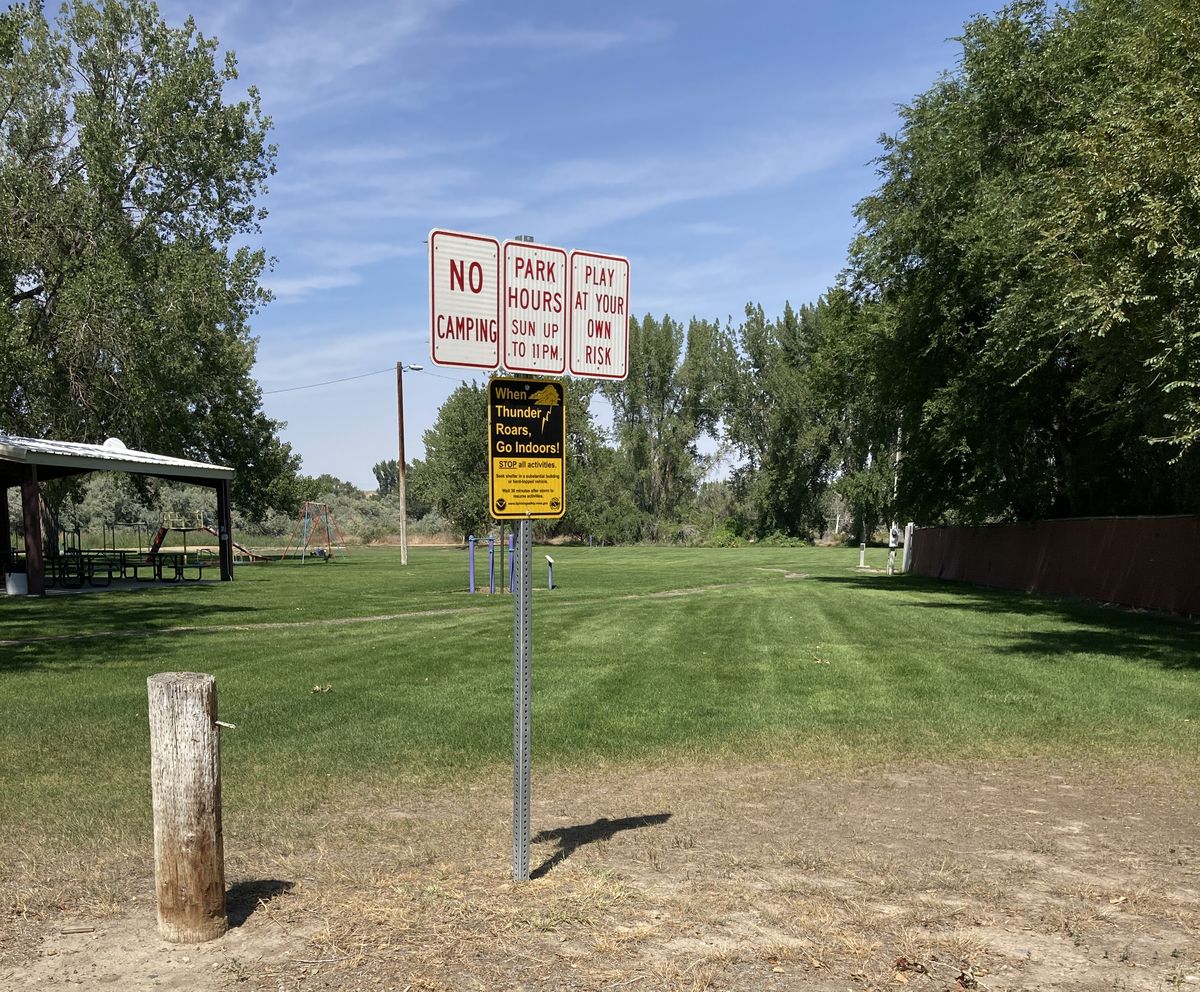
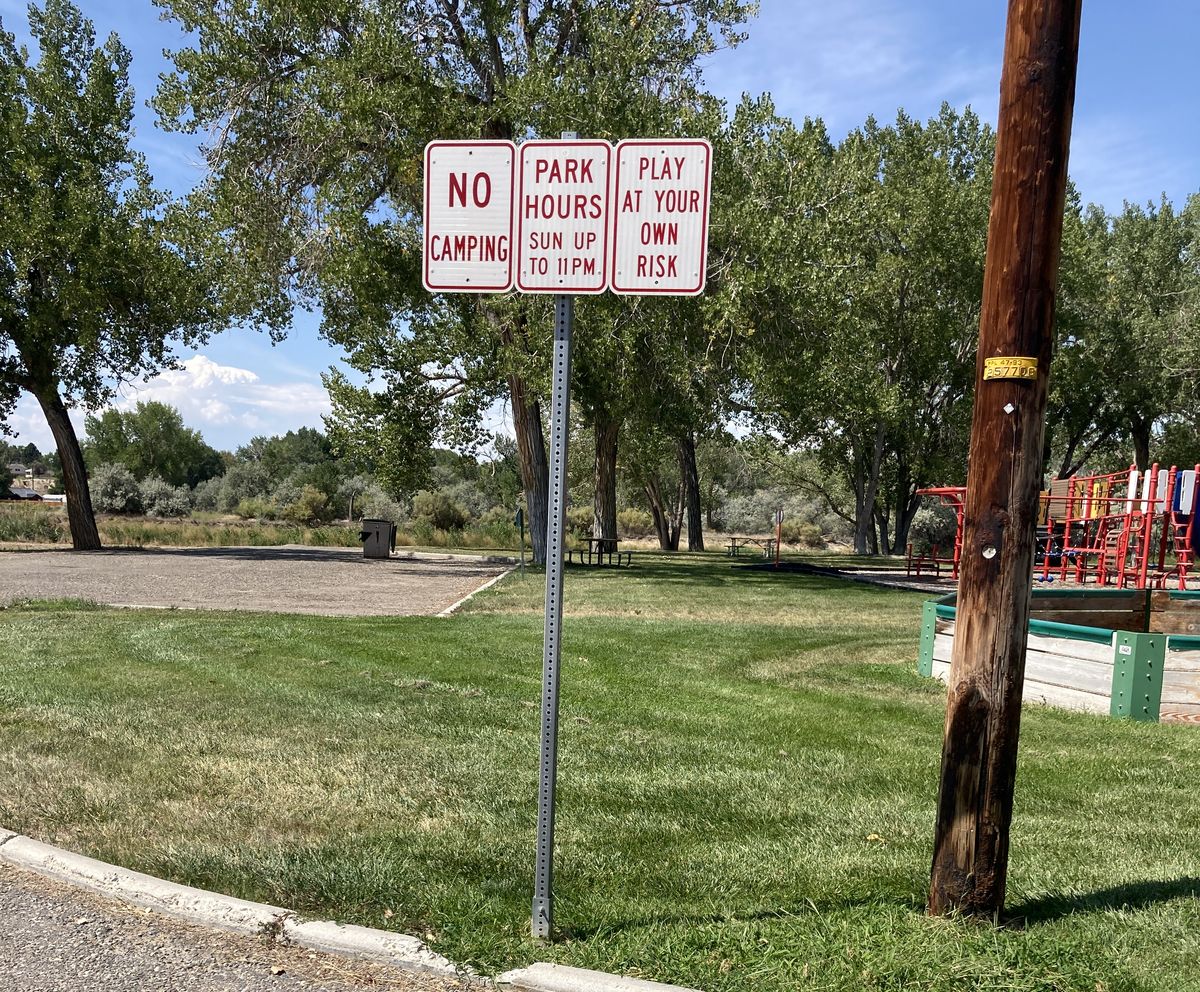
So the City posts rules in its parks — and does so at every entrance, not at one of them. It owns the posts. It has a supplier. Somebody drove out and fitted seven signs to two posts in a single park. Five of the seven state a rule; two disclaim liability. What is missing is not the capability, the hardware, the budget or the will to put up signage. It is six lines of text about the one subject that has actually injured somebody.
Set those three facts side by side. A resident in a park with a dog can consult the Code and find no parks chapter; look for a sign and find none; check the City website and find a reservation line. Three places to look, and the answer in none of them. The ordinance binds them regardless — not knowing the law has never been a defense — so the effect is a duty that is enforceable but not discoverable at the moment and place it applies.
This is not an expensive problem, and the City has already solved the harder half of it. The posts, the mountings and the procurement route all exist. The marginal cost of a fifth sign on that post is the cost of the sign. By contrast the airport — a far less-visited piece of public land — has had its own express pet provision since 1978.
S2 The article called “Dogs” contains the least of the dog law.
Chapter 4 is divided into five articles. Article III is headed DOGS. It holds four live sections: vicious dogs, vaccination, impoundment of unlicensed dogs, and bite confinement. Everything a dog owner is most likely to need is somewhere else — the leash rule, the impound fee, the destruction rule, waste, barking, nuisance and kennels are all in Article I (“In General”), and licensing is in Article IV.
A reader who follows the table of contents to Article III — Dogs, which is the obvious move, will not find the leash law, the license fee, or what happens if their dog is picked up.
S3 Two definitions of “at large,” and one of them excludes dogs.
Sec. 4-1(A) defines animal as all animals “with the exception of dogs and cats,” and defines at large as not under the owner’s immediate control. Sec. 4-1-1 defines at large again for dogs and cats, as not under control “by leash, cord, chain or otherwise.” Two different tests, forty-five words apart.
The consequence surfaces in Sec. 4-2 (Cruelty to animals), which makes it unlawful “to allow any animal to run at large in the City.” On the chapter’s own definition, that clause does not reach dogs. The prohibition that does reach dogs sits in a different section under a different test.
S4 Two impoundment regimes that count the same three days differently.
Sec. 4-1-4: a dog not redeemed “within three days after the date of impoundment” is destroyed or otherwise appropriately disposed of. Sec. 4-24: a dog taken for want of a license or vaccination tag is kept “at least three days, exclusive of the day of capture,” then “exterminated or destroyed and their bodies buried beyond the City limits.”
Different start point, different floor-versus-ceiling framing, different disposal method, and no cross-reference in either direction. A dog picked up while at large and unlicensed falls under both. The Code does not say which governs.
S5 An enforcement officer who does not exist in the Code.
The 2025 amendment to Sec. 4-25 gives discretion over home quarantine to “the Animal Control Officer or Peace Officer.” No Animal Control Officer is created, appointed, or defined anywhere in the Code.
Sec. 2-1 lists the officers the Mayor appoints — City Attorney, Clerk-Treasurer, Chief of Police, Municipal Judge, City Engineer, Superintendent of Public Works, Airport Manager. Animal control appears in Sec. 2-1(E) only as one of thirteen subject areas that Municipal Ordinance Officers may write citations for. Meanwhile Secs. 4-1, 4-1-3, 4-6, 4-7-3 and 4-7-4 assign the work variously to the Chief of Police, to “every police officer,” and to persons “designated by the City.” Four labels, one job.
S6 Since May 2025 a biting cat has been treated more seriously than a biting dog.
Two sections, both from the same 1951 ordinance, in nearly identical words. Sec. 4-25 governs dogs that have bitten someone; Sec. 4-12 governs cats. Each required the animal to be confined under the observation of a licensed veterinarian for ten days, at the owner’s expense.
Ordinance No. 879, adopted 6 May 2025 and effective 17 May 2025, amended the dog section only. It added: “Home quarantine may be allowed, as determined by and at the discretion of the Animal Control Officer or Peace Officer.” The cat section was left exactly as it was.
So the mandatory veterinary quarantine still stands for cats and has become discretionary for dogs. Anyone can verify this in thirty seconds: put Sec. 4-12 and Sec. 4-25 side by side. The cat section is the dog section’s own former wording, preserved in the live code.
This matters beyond the oddity of it. The ten-day quarantine is the mechanism by which a bite gets recorded, and in Wyoming — which has no strict-liability dog-bite statute — an owner’s liability turns on having been on notice, which in practice means an earlier incident having been written down. Making the quarantine discretionary makes a first bite easier to leave unrecorded. And the discretion was handed to an Animal Control Officer who, as S5 sets out, does not exist anywhere in this Code.
S7 The same duty enacted twice, with different consequences.
Sec. 4-3 makes failing to remove a dog’s excreta from public walks, public ways, parks, recreation areas or another person’s property unlawful. Sec. 4-7-2(A)(5)(c) makes essentially the same failure a public nuisance, in near-identical wording, with “public ways” and “parks” dropped from the list.
This is not harmless duplication. A public nuisance counts towards Sec. 4-7-3’s three-violation rule, which ends in mandatory destruction or relocation of the animal. The same act therefore carries two different exposures depending on which section is charged, and the two lists of places are not the same.
S8 The gravest power in the chapter has the least procedure.
Sec. 4-15 (enacted 1950) lets the municipal judge order a dog killed on conviction of its owner. It contains no definition of “notoriously vicious or cross,” no hearing on the dog’s behavior, no notice, no appeal, and no alternative such as a dangerous-dog registration or a secure-enclosure order. Sec. 4-7-3 imposes destruction or relocation after three nuisance violations, without defining what a “violation” is — a complaint, a citation, or a conviction.
Compare Sec. 4-30, the 2022 chickens ordinance: written application, thirty-day determination, conditional approval, revocation on specified grounds, written notice of revocation, ten-day written appeal to the City Council, forty-five-day decision. The newest provision in the chapter is procedurally the most careful; the one that can destroy a family’s animal is seventy-six years old and has none of it.
S9 Three numbering systems in one chapter, none of them the Code’s own.
Chapter 4 runs 4-1, 4-2, 4-3… and simultaneously 4-1-1 through 4-1-4 and 4-7-1 through 4-7-5. The Code’s own Preface states the rule for inserting new material between two sections: use the decimal system, so that a section between 6-1 and 6-2 becomes 6-1.5.
Chapter 4 ignores it. The effect is that Sec. 4-1-3 and Sec. 4-24 — both about impounding dogs — look like they belong to different topics, and Sec. 4-7-1 (kennels) looks like a subdivision of Sec. 4-7 (releasing impounded animals), which it has nothing to do with.
S10 A third of the dog sections are empty shells still shown to readers.
Reserved or repealed within Chapter 4: 4-5, 4-9, 4-11, 4-13, 4-14, 4-16, 4-18, 4-19 through 4-23, and 4-27 through 4-29.
The sharpest case is Sec. 4-18, catchlined “License; required,” repealed in 2013, still displayed in the table of contents under DOGS. A resident looking for the licensing rule sees exactly the heading they want, clicks it, and gets a repeal note. The live rule, Sec. 4-26, is in a different article with no pointer from 4-18 to it.
S11 Fees and penalties are scattered, and one is fifty years stale.
$50 impound redemption (4-1-3); a minimum board bill of $2.00 for small animals (4-1(F), set in 1978 and never revised); $50 surcharge above ten animals (4-4); $12.50 and $35.00 license fees (4-26); a $750 maximum fine and $10 costs (1-7, in a different chapter). There is no fee schedule anywhere in the Code, and no section in Chapter 4 links to Sec. 1-7 even though five of them are governed by it.
S12 Cats and dogs are split apart, then merged, then defined by each other.
Article II is cats, Article III is dogs, Article IV licenses both together, and Article I governs both without saying so in its heading. Sec. 4-10 then defines cat impoundment entirely by reference to dogs — cats “may be captured, impounded, and destroyed in the same manner as dogs.”
A cat owner must read the dog article to learn the rule for cats; a dog owner must read the general article and the licensing article to learn the rules for dogs. Neither can rely on the article headed with their animal.
S13 The zoning chapter borrows a definition that does not exist in the singular.
Sec. 24-7 (Zoning definitions) provides that “animal” has the same meaning as in Chapter 4. Chapter 4 supplies two competing meanings — the Sec. 4-1(A) definition that excludes dogs and cats, and the Sec. 4-7-3 definition of “owner” that assumes they are included. The cross-reference does not say which.
S14 Barking is a nuisance in the animals chapter and invisible in the noise chapter.
Worland has a Chapter 14A devoted to noise. Searching the whole code for animal returns no hit in Chapter 14A. Barking is regulated only at Sec. 4-7-2(A)(1), in undefined terms — “excessive, continuous or untimely” — with no decibel standard, no quiet hours, and no complaint procedure. Neither chapter cross-references the other.
S15 The Code’s stated organizing principle does not hold.
The Preface says the chapters “have been conveniently arranged in alphabetical order.” Chapter 11 is Solid Waste and Maintenance of Premises, sitting between Chapter 10A Flood Damage Prevention and Chapter 13 Licenses. Chapter numbers 6, 9, 10, 12, 18 and 21 do not appear at all; six chapters carry letter suffixes (2A, 7A, 10A, 14A, 18A, 21A) because they were inserted later.
Alphabetical order is what lets a reader guess where something lives without using search. Once it is broken and unmarked, browsing stops working and every visitor is pushed into a search box — which, as Part two shows, is where the trouble starts.
Part two — barriers for a visitor of average computer skill
The test applied here: an ordinary Worland resident, on a phone or a home laptop, who wants to know whether their dog needs a license and whether it can be off the lead in the park. Nothing exotic — no screen reader, no developer tools, no legal training.
U1 Search matches letters, not meaning.
Searching the code for park returns 57 results. The first several are Sec. 14-13 (vehicle parking), Sec. 14-11 (stopping, standing and parking), Sec. 14-5-3 (tractor trailer parking), Sec. 14-10 (limited parking zones), Sec. 24-10-12 (off-street parking). Chapter 14 alone accounts for ten of them. Searching barking returns Sec. 24-17-7, a zoning table of landscape materials priced by the hundred square feet of “decorative stone, rock or bark,” ranked above the barking-dog nuisance.
This is the single most damaging thing about the site for a lay user. The two most natural words a dog owner would type — park and barking — both return mostly noise, and there is no indication to the user that anything has gone wrong. They will conclude the rule does not exist.
U2 Nothing on the site answers a question; it only locates text.
There is no FAQ, no plain-language summary, no fee table, no “what happens if my dog is picked up” page, no license application form, no counter hours, and no phone number anywhere in the code content. A successful search hands the user a 1962 sentence about keeping an animal “securely confined on his premises” and leaves the interpreting to them.
To answer the leash question correctly a reader must combine Sec. 4-1-2 with the definition in Sec. 4-1-1, notice that Sec. 4-1 uses a different definition that excludes dogs, and then find Sec. 1-7 in another chapter for the penalty. That is four documents for one question.
U3 The address of a section is unusable by a human being.
The link to the bite-confinement rule is
…?nodeId=CH4ANFO_ARTIIIDO_S4-25CODOHABIPE.
It cannot be typed from memory, read aloud over a phone, written on a notice, or recognized when pasted into a
message. There is no short citation URL of the form /4-25.
Practical effect: a City employee cannot easily tell a resident where to look, and a resident cannot easily show a neighbor what they found. Verified by observation: opening a section link loads the entire chapter and scrolls to the section, so the browser’s back button and the page title both refer to the chapter, not to what the user is reading.
U4 A third of the screen is a table of contents the reader did not ask for.
The reading view is two panes: a persistent hierarchical contents tree on the left, the ordinance text on the right. On a 1282-pixel-wide window the tree occupies roughly 440 pixels, about a third. Both panes scroll independently, so the mouse wheel does different things depending on where the pointer happens to be.
On a phone this layout has to collapse, which means the contents tree becomes a hidden menu and the reader loses the only navigational cue the interface offers. This finding is based on the desktop layout as observed; the phone rendering was not captured directly and the conclusion about it is inference.
U5 Every section is buried under five identical buttons.
Each heading — chapter, article and section alike — carries the same row of controls: share link, print, download DOCX, email, compare versions. On the Chapter 4 page that row repeats more than forty times.
In the page’s plain-text form the phrase “SHARE LINK TO SECTION / PRINT SECTION / DOWNLOAD (DOCX) OF SECTIONS / EMAIL SECTION / COMPARE VERSIONS” appears between every pair of provisions. For anyone reading linearly — by screen reader, by text browser, or by copy-and-paste into a document — the controls outnumber the law. Screen-reader behavior itself was not tested.
U6 The download that is offered is the wrong format.
The per-section download button produces a Word DOCX file. A whole-publication PDF is offered separately, for the entire code. There is no way to take away just the dog provisions as a PDF, which is the format most people can open on a phone, attach to an email, or hand to someone.
U7 Results are paginated ten at a time, and the control that changes that is below the fold.
A 17-result search for dog is split across two pages; a 26-result search for animal across three. The “Results per page” selector sits underneath the pagination at the very bottom. Adding a results-per-page parameter to the URL had no effect when tried.
A user cannot see all the dog provisions on one screen at any point in the process — not in search, and not in the contents tree, which shows one chapter at a time.
U8 It is genuinely hard to tell what is current.
The reading pane is stamped “VERSION: OCT 27, 2025 (CURRENT).” The Code’s own title page says “Published in 2021.” The Preface describes a looseleaf binder supplement service and instructs the holder to insert replacement pages. Individual sections carry a small blue “modified” badge, and Sec. 4-25 carries one with an effective date of 17 May 2025.
Four different currency signals, in three registers, none of which says plainly: this text is in force today. The looseleaf instructions are addressed to someone who does not exist — a person holding a physical binder — and appear on the front page of a website.
U9 Translation is machine translation of criminal law.
The page offers a Google Translate widget listing roughly two hundred languages. Nothing visible beside it warns the reader that a machine translation of an ordinance is not the enacted text and cannot be relied on.
A Spanish-speaking resident in Worland gets a translation of a sentence that already requires three other sections to interpret. The failure mode is invisible: the translated text reads fluently and is wrong about the thing that matters.
U10 The penalty is never where the rule is.
Five provisions relevant to dogs end with “shall be punished as provided in Section 1-7 of this Code.” On the site, none of them links to Sec. 1-7. The reader has to leave Chapter 4, open Chapter 1, and scroll to the seventh section.
Sec. 4-1-2, the leash rule itself, does not even do that much — it states no penalty at all. The chain from “my dog was off the lead” to “the fine is up to $750 and each day counts separately” runs through Sec. 4-7-5 to Sec. 1-7, and is nowhere set out.
U11 The law is not in the page. A program has to run before any of it appears.
Worland’s ordinances are published through a system that delivers no ordinance text at all in the page itself. What arrives is an application; the words of the law appear only once a browser has run it. Ask the server for the page containing Sec. 4-25 and you receive a shell — site metadata, and no dog law.
Verified repeatedly in preparing this report: every attempt to read the code by ordinary retrieval returned a page containing none of it. The text on the Ordinance Text page here had to be captured by driving a live browser, because there was no other way to obtain it. Compare Cody, ninety miles away and roughly twice Worland’s size, whose ordinances are published as plain web pages that arrive complete and can simply be read: codelibrary.amlegal.com/codes/codywy.
This is not a complaint about modernity. It has consequences for particular people. A reader on a slow rural connection waits for an entire application to load before a single word of the law appears. Assistive technology has a harder job with text assembled by a program than with text that is simply present. Saving a section, printing it, or quoting it into a document all become awkward. And anyone building something useful on top of the City’s own published law — a summary, an index, a guide of the kind these pages are — must first defeat the way it is delivered.
The City did not design this and could not reasonably have been expected to evaluate it. It bought a product. But it is a choice, another vendor is making a different one a short drive up the road, and the difference is visible to any resident who tries to use both.
Part three — what would fix it
Ordered by benefit per unit of effort. The first three need no ordinance amendment at all.
1. Publish a one-page dog guide on the City website.
License fees and deadline, leash rule, waste rule, what happens at impound, the vaccination requirement, and a phone number. One page, plain sentences, linked from the code, and put the same six lines on a sign in each park. This addresses U1, U2, U6, U10 and half of S1 at once and costs nothing legally — the pages you are reading are a working demonstration of the format.
2. Add short, human citation links.
A redirect so that worlandwy.gov/code/4-26 reaches the licensing section would make it possible for a clerk to say the address out loud and for a resident to write it down. This is a redirect table, not a rebuild.
3. State the currency of the text in one plain sentence.
“This text is in force as of [date]. Ordinances adopted after that date are listed here.” Remove or relabel the looseleaf binder instructions, which no longer describe how anyone reads this code.
4. Consolidate the dog provisions into the article named Dogs.
Move the leash rule, impoundment, destruction, waste, nuisance and kennel provisions as they apply to dogs into Article III, or renumber the chapter so that Article I is expressly the general article for all animals including dogs. Resolve the two “at large” definitions into one. This is the fix for S2, S3 and S9.
5. Reconcile the two impoundment tracks, and settle who enforces.
One holding period, one method of counting it, one disposal rule, with a cross-reference between the sections that survive. Define the Animal Control Officer, or amend Sec. 4-25 to name an office that exists. S4 and S5.
6. Give the vicious-dog power a procedure.
Define the standard, provide notice to the owner, a hearing on the dog’s behavior, and an appeal — at least what the 2022 chicken ordinance already provides for a coop. Define what counts as a “violation” for the three-strikes rule in Sec. 4-7-3. S8.
7. Put a sign in every park, and settle the parks question in the Code.
These are two jobs and the first does not wait on the second. A sign at each of the ten parks — dogs welcome on a lead, clean up after them, and the number to ring — requires no ordinance, no Council vote and no legal drafting, and it closes the discoverability gap immediately. Then, separately, decide in the Code whether dogs are permitted, on lead, in which parks, and whether any area is off-lead, so that the sign has something behind it. S1.
9. Ask the codifier what else is on offer — and what this costs.
Before the next renewal, ask two questions: what the City pays for the present publishing arrangement, and whether a version is available that delivers the text of the law in the page rather than assembling it with a program. Other Wyoming municipalities are published in that plainer form. This costs nothing to ask and it is the kind of question a council is entitled to put to a supplier. U11.
8. Retire the empty sections, or point them somewhere.
At minimum, make Sec. 4-18 say “repealed; see Sec. 4-26” rather than showing a reader the heading they want and then nothing. S10.
Appendix — the chapter list as published
| Ch. | Subject | Note |
|---|---|---|
| 1 | General Provisions | Contains Sec. 1-7, the penalty for most dog offenses |
| 2 | Administration | Sec. 2-1 lists who enforces animal control |
| 2A | Airports and Aircraft | Sec. 2A-22(E), the only place-specific dog rule |
| 3 | Alcoholic Beverages | |
| 4 | Animals and Fowl | The dog chapter |
| 5 | Bicycles, Skateboards, Roller Skates and Rollerblades | |
| 7 | Buildings and Construction | No Chapter 6 |
| 7A | Cemeteries | |
| 8 | Courts, Fines and Imprisonment | |
| 10A | Flood Damage Prevention | No Chapter 9 or 10 |
| 11 | Solid Waste and Maintenance of Premises | Out of alphabetical sequence |
| 13 | Licenses | No Chapter 12; does not cover dog licenses |
| 14 | Motor Vehicles and Traffic | Source of most “park” search noise |
| 14A | Noise | Contains nothing about animals |
| 15 | Offenses; Miscellaneous | |
| 16 | Pawnbrokers | |
| 17 | Peddlers, Transient Merchants and Itinerant Vendors | |
| 18A | Signs | No Chapter 18 |
| 19 | Streets and Sidewalks | |
| 20 | Subdivisions | |
| 21A | Telecommunications | No Chapter 21 |
| 22 | Trees and Shrubbery | Defines “park trees” |
| 23 | Water and Sewers | |
| 24 | Zoning | Sec. 24-7 borrows Chapter 4’s definition of “animal” |
Twenty-four chapters, six of them added later with letter suffixes, six plain numbers unused, and no chapter for parks and recreation — which is why the question “can my dog go to the park?” has nowhere in this list to live.
Provenance
Recorded here so that anyone reading this audit can see exactly what was asked for, by what means it was produced, and how long it took — and can judge the result against the request.
The instruction that produced these pages
Reproduced as entered on 25 August 2026. One passage — a file path on the author’s own computer — has been replaced with a placeholder in square brackets. Nothing else has been altered, added or removed.
Audit the part of the Worland, WY municipal website which presents ordinances to the public concerning dogs, from the main url, [https://library.municode.com/wy/worland/codes/code_of_ordinances], for structure and usability. Create an alternate static HTML website with three pages, with simple navigation between them. The first page, index.html, is a clickable index of ordinances relating to dogs, with, at the top, a section of Frequently Asked Questions, including, Leashing of Dogs, Licensing, and Dogs in City Parks. The second page is the text of the sections of the regulations cited by the index. The third page is an audit report of: the structure (highlighting logical inconsistencies), and barriers to website visitors of average computer skills to make use of the ordinance text. Make all pages optionally downloadable as PDF, and make the HTML code responsive. The three output html files go into [a folder on my computer]. Optimize all for upload as a github Page. Supply step-by-step instructions for uploading to an existing github repo, https://github.com/FB-Decipherer/worland-wy-dog-laws, where all existing files may be overwritten. The files should be publicly viewable.
How long it took
| Phase | Elapsed |
|---|---|
| Reading the Worland code through the Municode interface | about 10 minutes |
| Writing the stylesheet and the three pages | about 6½ minutes |
| Verification — link checking, responsive rendering, PDF output, one bug fixed and re-tested | about 2 minutes |
| Delivery and notes | about 1½ minutes |
| Total | about 20 minutes, 19:08 to 19:29 UTC on 25 August 2026 |
Timings are taken from the build workspace’s own file timestamps. The boundary of the research phase is inferred rather than measured, because reading a website leaves no file behind — it is dated from the moment the first page file was created.
How it was made, and what was checked
What was read, and how. The Worland Code of Ordinances as published on Municode, site version dated 27 October 2025, read on 25 August 2026 — the whole of Chapter 4, together with Sec. 1-7, Sec. 2-1 and Sec. 2A-22, plus whole-code searches for dog (17 results), animal (26), park (57) and barking (3), and the chapter facet listing, which is how the absence of a parks chapter was established. The parks themselves were visited in August 2026.
The code had to be read by driving a live browser and capturing the rendered text, because requesting the pages directly returns a shell containing no ordinance text at all. That is not merely a note on method — it is finding U11.
These pages were compiled with the help of an AI assistant (Claude, made by Anthropic), used to read and organize a large and badly structured body of ordinance text. That is disclosed here for the same reason the timings and the untested items are: a document that criticises another for being hard to check should be easy to check itself. Every ordinance citation was verified against the City’s own published code, and the parks were visited in person.
Before delivery: all 77 internal links and anchors were resolved (none broken); the three pages were rendered at 390 pixels and 1200 pixels wide and confirmed to produce no horizontal scrolling at either size; and each page was printed to PDF to confirm the print stylesheet suppresses navigation and expands every collapsed FAQ entry. That last check caught a real fault — a browser will not print the contents of a closed disclosure element on the strength of a stylesheet rule alone — which was fixed and re-tested rather than shipped.
Three things were not tested and are not claimed anywhere in this report: assistive-technology behavior with a screen reader, and the output of Municode’s own DOCX and PDF download buttons. Whether the parks carry posted rules was originally listed here as an unknown; it was checked on the ground in August 2026 and moved into the findings as S1.