
Frequently asked questions
Twelve questions dog owners in Worland actually ask. Click any one for the answer, with the sections of the Code it comes from.
Dogs in city parks — are they allowed?
Yes — on a leash. There is no ordinance that bans dogs from Worland’s parks, and equally there is no ordinance that grants them access, sets park hours for dogs, or creates an off-leash area. In fact the Worland City Code has no parks and recreation chapter at all.
So parks are governed by the general rules. A park is a public place, which means the leash rule in Sec. 4-1-2 applies: the dog must be on a chain, cord or leash. Parks and recreation areas are named explicitly in the waste rule, so you must pick up after your dog there. And a dog that molests people or passing bicycles, or barks excessively, is a public nuisance wherever it does it.
And nothing tells you any of this at the park. A check on the ground in August 2026 found no sign about dogs at any Worland city park — nothing about leads, nothing about cleaning up, nothing about reporting a loose dog or a bite. Signs are not the difficulty: the post at the entrance to Rotary Riverside Park carries four of them — no camping, park hours, play at your own risk, and what to do in a thunderstorm. The City posts rules in its parks. It has simply never used one to say anything about dogs. The City’s own parks page publishes no rules either: it gives a telephone number for shelter reservations and nothing more. So a resident standing in a park with a dog has three places to look and finds the answer in none of them — not the Code, which has no parks chapter; not a sign; not the City website. The rules still apply.
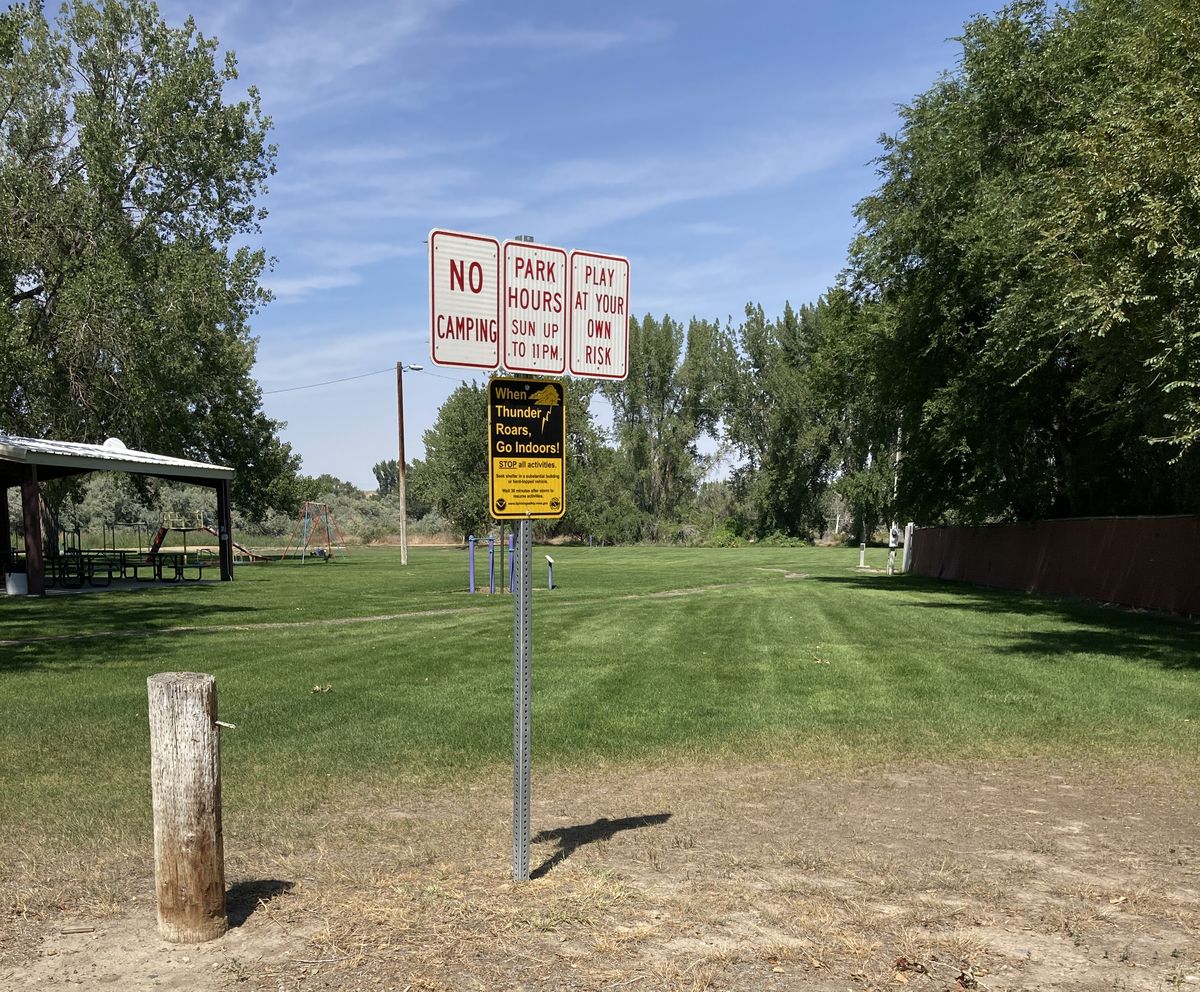
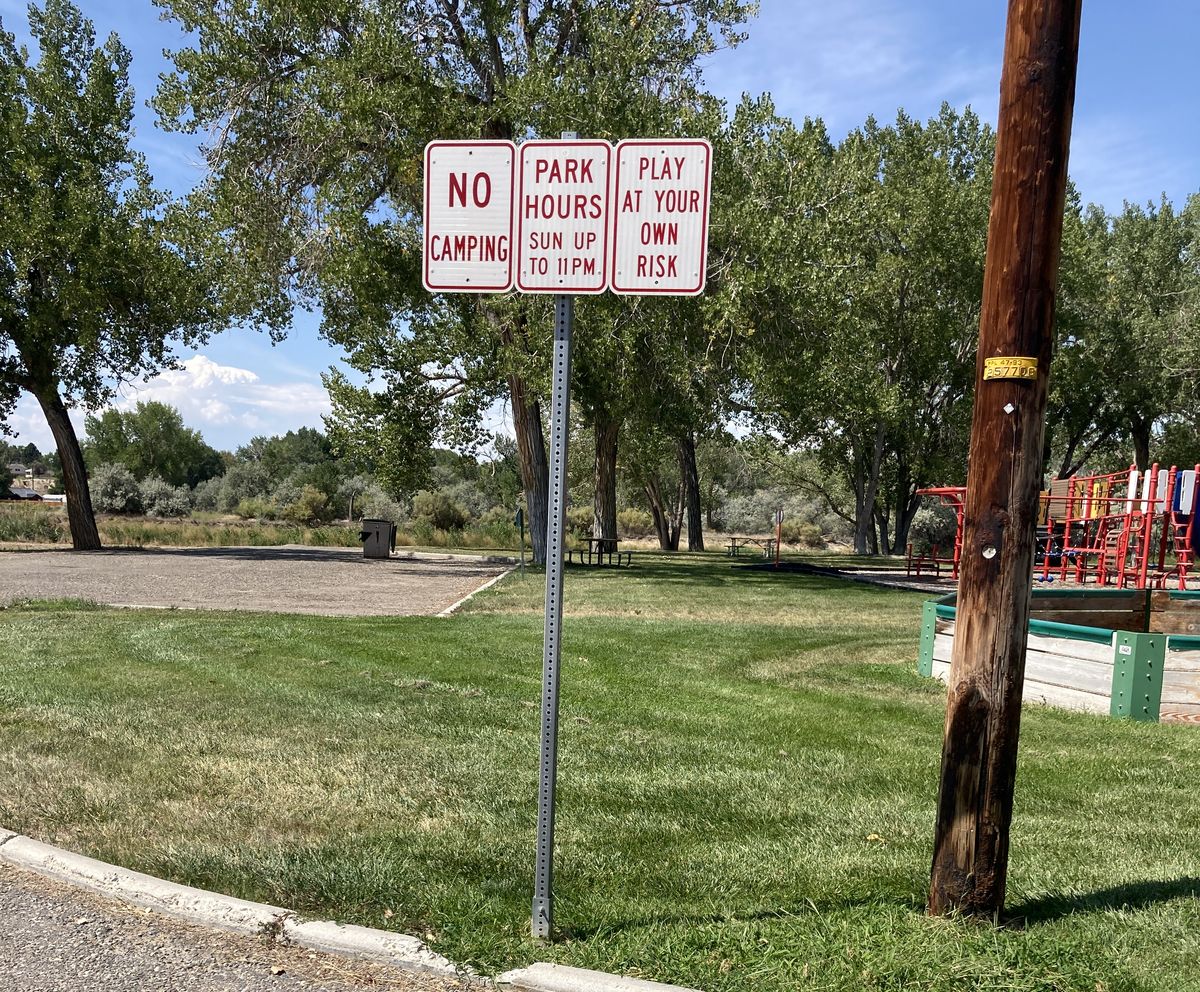
That is the gap this page exists to close. One further thing worth knowing: the airport is the one public place in Worland with a dog rule of its own, and it is stricter than the general rule — see below.
Where it says so: Sec. 4-1-2 (leash in public places) · Sec. 4-3 (waste in parks and recreation areas) · Sec. 4-7-2 (nuisance behavior) · Sec. 2A-22(E) (airport)
Leashing of dogs — does Worland have a leash law?
Yes, effectively. The rule is written as a confinement rule rather than a leash rule: every owner must keep a dog securely confined on their own premises. The leash is the exception that lets you leave the property — you may have your dog on the streets and public places of the City when the dog is controlled by a chain, cord or leash.
There is no length limit on the leash, no voice-control exception, and no off-leash area anywhere in the Code. A dog off your property and not on a leash, cord or chain is “at large,” and any police officer has a duty to pick it up.
A female dog in season must be confined so that other dogs cannot reach her.
Where it says so: Sec. 4-1-2 (the rule) · Sec. 4-1-1 (what “at large” means) · Sec. 4-1-3 (what happens if your dog is picked up)
Licensing — who needs a license, when, and what does it cost?
Every dog five months of age or older must be licensed for each calendar year. Licenses run 1 January to 31 December. It is an offense to keep an unlicensed dog in the City after 31 January.
| Dog | Fee per year |
|---|---|
| Neutered male or spayed female | $12.50 |
| Unneutered male or unspayed female | $35.00 |
| Surcharge if you keep more than ten dogs and cats combined | $50.00 on top of the ordinary fees, due by 31 January |
Before a license is issued you must show proof of current rabies vaccination. You get two tags from the City Treasurer — a numbered license tag and a separate vaccination tag in a different color or design — and the Code says both are to be worn by the dog at all times. If you acquire a dog part-way through the year, the fee is prorated from the date you got it. Proof that the dog is spayed or neutered must be produced at the time of licensing to get the lower fee.
If you are cited for a first offense and then license the dog, the charge is dismissed.
Litters of legally bred, properly licensed pets do not count towards the ten-animal threshold until they reach four months old.
Where it says so: Sec. 4-26 (license requirements and fees) · Sec. 4-17 (rabies vaccination) · Sec. 4-4 (more than ten animals) · Sec. 4-24 (impoundment of unlicensed dogs)
Picking up after your dog
You must remove what your dog deposits on public walks, public ways, parks, recreation areas, and on private property that is not yours. Failing to do so is expressly unlawful.
The same duty is written a second time, in almost the same words, as a “public nuisance” in Sec. 4-7-2. That matters, because nuisances carry a three-strikes consequence that the plain offense does not — see the barking answer below.
Where it says so: Sec. 4-3 · Sec. 4-7-2(A)(5)(c)
Barking, howling and a dog that bothers people
A dog is a public nuisance if it molests people or passing vehicles including bicycles, or if it barks, whines or howls “in an excessive, continuous or untimely fashion.” None of those three words is defined, and there is no decibel standard, no time-of-day cut-off and no complaint procedure in the Code. Worland’s separate noise chapter (Chapter 14A) does not mention animals.
The consequence is unusually severe and worth knowing. An animal that is the subject of three violations is declared a habitual public nuisance on the third, and on the court’s determination the owner must have it destroyed or relocated outside the City within ten days. If it is not moved, it is disposed of under the direction of the Chief of Police. The Code does not say whether a “violation” means a complaint, a citation or a conviction.
Where it says so: Sec. 4-7-2(A)(1) (what counts) · Sec. 4-7-3 (three strikes) · Sec. 4-7-5 (penalty)
If a dog bites someone
Any dog that has bitten a person must be confined under the observation of a licensed veterinarian for ten days after the attack, at the owner’s expense, to check for disease communicable to humans. Since a 2025 amendment, home quarantine may be allowed instead, at the discretion of the Animal Control Officer or a Peace Officer.
Separately, a dog that is notoriously vicious or cross, or that shows a disposition to bite, may not be kept at all unless it is properly secured and muzzled. On conviction, if the dog is still alive, the municipal judge may order a police officer to have it killed, and officers may enter premises for that purpose. This provision dates from 1950. There is no definition of “vicious,” no dangerous-dog hearing, and no appeal written into it.
Where it says so: Sec. 4-25 (ten-day confinement) · Sec. 4-15 (vicious or cross dogs)
If your dog is picked up — fees, holding times, and the deadline
Two different tracks exist, and which one applies depends on why the dog was taken.
Picked up running at large. You pay the City Treasurer a $50 fee for taking up and receiving the animal, plus the veterinarian’s daily impoundment charge, before the dog is released. A dog not redeemed within three days after the date of impoundment is destroyed or otherwise disposed of.
Picked up without a license tag or vaccination tag. The dog is held at least three days, exclusive of the day of capture. If it is not claimed and the licenses bought, it is exterminated and buried beyond the City limits.
The two rules count the three days differently and describe the ending differently, and neither refers to the other. In practice, treat three days from the day the dog was taken as the outside limit and act immediately.
Where it says so: Sec. 4-1-3 · Sec. 4-1-4 · Sec. 4-24
Rabies vaccination
It is unlawful to own or keep a dog in the City without having it inoculated or vaccinated for rabies by a licensed veterinarian, and you must hold the vet’s certificate as proof. Dogs must stay current, as determined by a veterinarian — the Code sets no fixed interval of its own. Proof of current vaccination is a precondition of getting a license.
Where it says so: Sec. 4-17 · Sec. 4-26(C)
How many dogs may I keep? Can I breed them?
There is no cap on the number of dogs. Above ten dogs and cats combined you simply pay an extra $50 a year.
Breeding is a different matter. Keeping a “kennel” anywhere in the City is declared a nuisance and is punishable. The Code’s definition is narrow and easy to trip over: a kennel is any premises where more than one female dog is kept for breeding purposes, or where more than one litter of pups is kept for the purpose of sale. Two intact females kept for breeding is, on the face of it, a kennel.
Where it says so: Sec. 4-4 (ten-animal surcharge) · Sec. 4-7-1 (kennels)
Dogs at the Worland Municipal Airport
Stricter than anywhere else in the City, and the only place with a dog rule of its own. No dog may enter the aircraft operation areas at all. No pet may enter the public use areas of the passenger terminal, except an animal helping a disabled person or one secured in a carrier for transport aboard an aircraft. Elsewhere on airport land dogs are allowed if leashed or otherwise under control, and owners must repair or remove any damage or debris their animal causes. Working animals under the control of a peace officer or authorised post office, airport or air carrier employee are exempt.
Where it says so: Sec. 2A-22(E)
What are the penalties?
Most dog offenses carry no penalty of their own; they fall back on the Code’s general penalty. That is a misdemeanor, a fine of not more than $750, plus costs not exceeding $10. Each day a violation continues is a separate offense, which is how a small matter becomes an expensive one.
Two dog-specific consequences sit outside the fine: destruction or relocation of an animal declared a habitual public nuisance after three violations (Sec. 4-7-3), and a judge’s order to destroy a vicious dog on conviction (Sec. 4-15).
Where it says so: Sec. 1-7 (general penalty) · Sec. 4-7-5 (penalties for Article I)
Who enforces these rules?
Honest answer: the Code is not consistent about it. Sec. 4-1 assigns impoundment and agreements with animal hospitals to the Chief of Police. Sec. 4-1-3 makes it the duty of “every police officer” to apprehend dogs at large. Sec. 4-7-4 lets the Chief of Police or designees use chemical immobilisation. The 2025 amendment to Sec. 4-25 gives discretion to “the Animal Control Officer or Peace Officer” — but no Animal Control Officer is created, appointed or defined anywhere in the Code. Sec. 2-1 lists the officers the Mayor appoints, and animal control appears there only as one of the areas that Municipal Ordinance Officers may cite for.
For anything practical — buying a license, reporting a stray, reclaiming a dog — contact the City of Worland directly. The Code does not publish a counter, a phone number or a form.
Where it says so: Sec. 4-1(K) · Sec. 4-1-3 · Sec. 4-7-4 · Sec. 4-25
Index of ordinances that apply to dogs
Every section below is reproduced in full on the Ordinance Text page. Sections are grouped by what they do, not by where the Code files them — the two are not the same, which is the subject of the audit.
Where a dog may be, and on what
- Sec. 4-1-1Running at large; dogs and cats; definitionsDefines “at large,” “dog” and “owner” for the dog rules. Article I.
- Sec. 4-1-2Running at large; dogs and cats; prohibitedThe confinement and leash rule. This is Worland’s leash law. Article I.
- Sec. 4-1Running at large; generallyThe parallel rule for all other animals and fowl — expressly excludes dogs and cats. Article I.
- Sec. 2A-22(E)Control of pets at the Worland Municipal AirportThe only place-specific dog rule in the Code. Chapter 2A.
Licensing, tags and vaccination
- Sec. 4-26License requirementsAge, dates, fees, tags, proof of vaccination and spay/neuter. Article IV.
- Sec. 4-17Annual vaccination of dogsRabies inoculation and the certificate you must hold. Article III.
- Sec. 4-4Multiple pet licensesThe $50 annual surcharge above ten dogs and cats combined. Article I.
- Sec. 4-18License; requiredRepealed in 2013 — still listed under “DOGS” in the official table of contents. The live rule is Sec. 4-26.
Nuisance, noise and waste
- Sec. 4-7-2Public nuisanceBarking, howling, molesting people and bicycles; waste accumulation. Article I.
- Sec. 4-7-3Owner’s responsibilityDefines “owner” again, and sets the three-violation destroy-or-relocate rule. Article I.
- Sec. 4-3Animal wasteThe duty to pick up, including in parks and recreation areas. Article I.
Bites, vicious dogs and cruelty
- Sec. 4-25Confinement of dogs that have bitten personsTen-day veterinary observation; home quarantine since 2025. Article III.
- Sec. 4-15Keeping cross or vicious dogsMuzzling requirement and the court’s power to order destruction. Article III.
- Sec. 4-2Cruelty to animalsAbuse, neglect, abandonment; food, water and shelter. Article I.
Breeding and kennels
Impoundment, redemption and disposal
- Sec. 4-1-3Impoundment; redemption fee$50 to the City Treasurer plus the veterinarian’s daily charge. Article I.
- Sec. 4-1-4Destruction of impounded dogs and catsThree days after the date of impoundment. Article I.
- Sec. 4-24Impounding dogs not properly licensed or vaccinatedA second, differently worded three-day rule. Article III.
- Sec. 4-7-4Chemical immobilizationAuthority to tranquilise animals at large. Article I.
Interfering with enforcement, and penalties
Empty slots in the dogs article
Listed for completeness, because they appear in the City’s own table of contents and a reader looking for a rule can land on them and find nothing.